


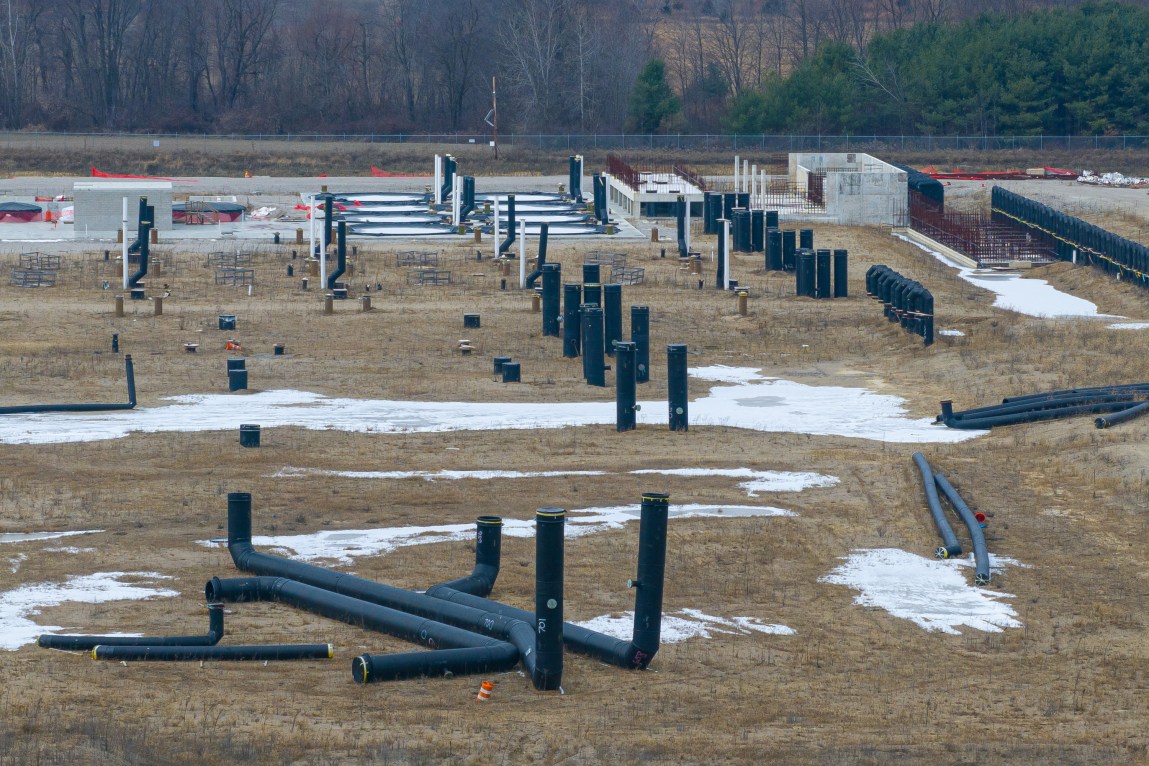

When a biotech company named AquaBounty Technologies announced plans to farm genetically engineered Atlantic salmon at a new plant in Ohio, local and state officials eagerly provided it with incentives. Not long after, the company paused construction and auctioned off “new” and “unused” equipment. Now, the state’s private economic development arm wants its $1 million back.
JobsOhio has requested repayment from AquaBounty by Sunday, according to a company filing with the Securities and Exchange Commission. The filing also notes that, at the end of September, AquaBounty was down to three employees and $122,255 in cash.
AquaBounty said that its salmon could thrive in indoor freshwater farms and help feed the world. Announced in 2021, the new development in Pioneer, Ohio, was supposed to be its first large-scale production facility.
The project came with promises of 112 new jobs, plus more resources for schools and infrastructure. It was believed to be the largest investment ever in rural Williams County.
But AquaBounty, which had never made a profit over its 30 years in business, faced a tangle of regulatory challenges and pushback from environmentalists.
Locals were also suspicious of how the village mayor’s personal interests were tied up in the project. Among other moves, Pioneer Mayor Ed Kidston bought land that AquaBounty wanted to build on. He then sold it to the company for $1.5 million more than he’d paid.
AquaBounty’s plan was unproven, but, as ProPublica reported last year, the company was buoyed by state and local resources — including the million-dollar grant from JobsOhio. The company received the money in August 2021, according to financial filings, shortly after the project went public.
“Why the state was so eager to promote this industry is really puzzling,” said Sherry Fleming of Williams County Alliance, a grassroots environmental group. While AquaBounty had genetic engineering know-how, she said it seemed to have limited experience in production.

In response to ProPublica’s queries, a press contact for AquaBounty said it shares what it can in its SEC releases and filings, and that it’s still in discussion with JobsOhio over the repayment demand. AquaBounty’s filing said that “there can be no assurance that JobsOhio will agree to any payment schedule or other accommodation.”
“Any collection or legal action by JobsOhio could result in additional costs and management distraction,” it added.
Kidston didn’t respond to requests for comment. He said at the time that his actions involving the plant were intended only to help the community. The village administrator referred ProPublica to AquaBounty and its website.
JobsOhio operates privately but has a funding mechanism set up by the state and a board appointed by the governor. Matt Englehart, a spokesperson for JobsOhio, said in an email to ProPublica that it “operates with transparency and accountability,” but its limited disclosures have long been a sore point for Ohioans.
On its website, JobsOhio says its funding model for specialized grants is “independent” and accommodating of “unique needs.” Qualifications include, but aren’t limited to, “job creation, additional payroll, fixed-asset investment commitment, project return on investment, and project location.”
The AquaBounty grant depended on not only the creation of jobs, but also $222 million in capital investment and a payroll of more than $5.4 million by the end of 2026. It had to maintain those commitments through the end of 2028.
Less than two years after it got the money, construction stalled. Roughly 30% built, the site languished at the end of Kexon Drive, a smooth new road that Pioneer had extended for its benefit.
AquaBounty sold equipment intended for the Ohio farm in 2024 and 2025. It also sold its intellectual property for genetically engineered salmon. By the end of September, according to its filing, its primary remaining assets were unsold equipment, the land in Pioneer and the incomplete build.
JobsOhio and other economic development boosters should “take a good look at this because they’re putting taxpayer dollars at risk when they advertise to bring these industries in, and they haven’t done their homework to protect the community,” Fleming said.
Englehart told ProPublica that he can’t discuss a situation that may result in litigation. But with any company, he said, “when metric commitments are not met, we work closely with those businesses” to help them overcome challenges.

If all options are exhausted, he added, “we will claw back some or all of our dollars so they can be used for future economic development projects to benefit Ohioans.”
JobsOhio’s demand notice came in September, the financial filing said, informing the company that its equipment sales and consideration of acquisition offers for the Ohio farm were a breach of the grant agreement.
AquaBounty “provided additional information” to JobsOhio in October, the filing said, but the agency upheld its demand and requested repayment this month. If it doesn’t come, the filing said, JobsOhio may refer the matter for collections and “pursue the remedies available” under the grant agreement.
With an onerous process and uncertain outcomes, it’s “pretty rare” for JobsOhio to try to claw back money, said Kristan Wong Karinen, a research analyst with the nonprofit Good Jobs First, which tracks public subsidies in economic development. More commonly, she said, it and other agencies will renegotiate the contract — extending the time period for a company to meet commitments, perhaps, or lowering requirements.
“In this case, with AquaBounty,” Wong Karinen said, “because they haven’t done anything, they haven’t fulfilled any of the requirements, I feel like JobsOhio is being forced into this.”
The post Ohio Jobs Program Wants Its Money Back After Company’s Failure to Deliver GMO Salmon appeared first on ProPublica.