


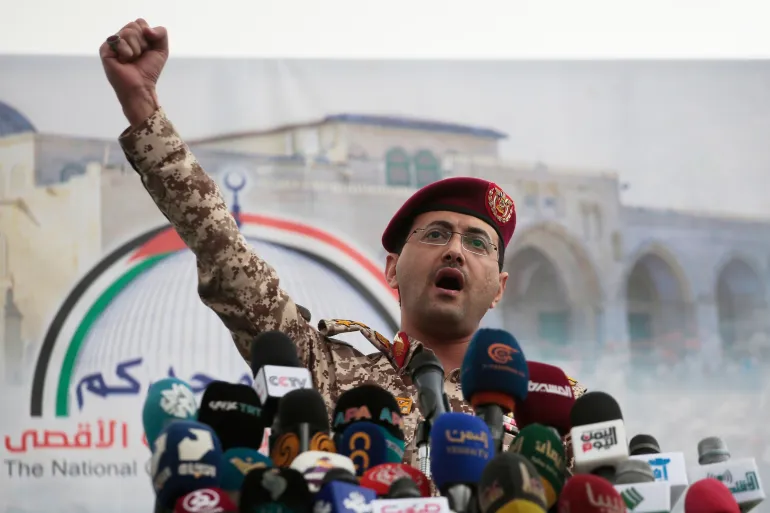
The Houthis are also a close ally of Iran, and now they say that their latest attacks are on behalf of the “Palestinian and Iranian peoples”, according to the Telegram account of Houthi spokesperson Yahya Saree, who added that the Yemeni group were coordinating with “the operations carried out by the Iranian army against the criminal Israeli enemy”.
On Sunday, two days after Israel first attacked Iran in the early hours of June 13, the Houthis announced that they had targeted Israel.
In a televised address, Saree said the group fired several ballistic missiles at Jaffa.
The Houthis are timing their attacks with the Iranians, according to Hussain Albukhaiti, a pro-Houthi political commentator.
The Houthis are launching missiles “after Iran launched its missiles”, Albukhaiti told Al Jazeera. “This way the Zionist settlers [Israelis] keep going back and forth to their
shelters so they can live a small fraction of the fear they caused the Palestinian people in Gaza.”
The Houthi attacks are essentially a continuation of their previous periodic missile and drone attacks on Israel. The Israelis have mostly been able to intercept the attacks but some have gotten through, most notably an attack in early May on Ben Gurion airport that injured six people and led to a suspension of flights.
But the Houthi attacks have also had another consequence for Israeli defences, according to Yemen expert Nicholas Brumfield.
“The constant threat of Houthi attacks coming from the south requires Israel to spread out its air defences rather than positioning them all to more effectively [defend] counterattacks coming from Iran,”
In November 2023, the Houthis began attacking ships they say were linked to Israel in the Red Sea. International ships that travel to the Red Sea are forced to pass Houthi-controlled areas of Yemen.
The attacks have ceased in recent months, particularly after the Houthis and the United States came to an agreement to stop attacking each other in early May, following a US bombing campaign that is reported to have killed more than 200 people in Yemen.
But the attacks could still resume, and the Houthis never agreed to stop targeting Israel, which itself has also continued to bomb Yemen.
“We had an agreement with the US to stop attacking each other, but Yemen will not obey this agreement if the US joins the Zionists in their attacks against Iran,”
Albukhaiti said.
“We remember that Trump cancelled the nuclear deal between Iran and the US,” he said, referring to the US president’s unilateral withdrawal from the nuclear deal between Iran and several Western countries in 2018. Albukhaiti accused Trump of cancelling the deal because it was not in Israel’s interest.
“Yemen will do the same, and will cancel the agreement with the US, because it’s not in the interest of Iran, which is an important ally of Yemen,” he said, referring to the Houthi rebel group as “Yemen”, although the group’s government is not recognised internationally.
Iran has also threatened to close the Strait of Hormuz, which lies between it and Oman. About 20 million barrels per day (BPD), or the equivalent of about 20 percent of global petroleum liquids consumed, pass through the Strait of Hormuz, according to the US Energy Information Administration (EIA).
Analysts said the Houthis could potentially do the same in the Red Sea.
Sea mines are “very low-tech, easy-to-make mines that would nevertheless introduce considerable uncertainty for global shippers,” Brumfield said.
“I don’t think that Iran or Yemen will hesitate to use sea mines if necessary to block the entire shipping lines in our region,” Albukhaiti added.